Paper marketing isn’t dead, it’s just gotten smarter. While everyone else is dumping money into Facebook ads and Google listings, a well-designed house cleaning flyer can land directly in the hands of homeowners who actually need your services. The trick isn’t blanketing every mailbox in town: it’s creating a flyer that looks professional, communicates value instantly, and makes it dead simple for prospects to reach out. Whether someone’s launching a cleaning business or trying to fill gaps in their schedule, a strategic flyer campaign can generate steady leads without burning through a marketing budget.
Table of Contents
ToggleKey Takeaways
- House cleaning flyers cut through digital noise and reach homeowners at moments when they’re thinking about outsourcing chores, making them more effective than broad online campaigns for local service businesses.
- An effective house cleaning flyer must include a problem-solving headline (8 words or less), a specific limited-time offer, and large contact information (18–22 pt) positioned at both top and bottom for maximum visibility.
- Color psychology and high-contrast design significantly influence response rates—blue conveys trust, green suggests eco-friendly practices, and dark text on light backgrounds always outperforms reverse printing.
- Door hangers outperform mailbox flyers in most residential areas because they’re immediately visible upon arrival home and avoid being dismissed as junk mail before being read.
- Strategic distribution targeting neighborhood demographics and timing (Thursday–Friday for families, Sunday for young professionals) combined with A/B testing of different headline and offer versions yields measurable results.
- Professional design requires only consistent alignment, two font families maximum, and a simple 2–3 color palette; paired with high-resolution images showing results and adequate white space, this approach beats complexity without expensive design fees.
Why House Cleaning Flyers Still Work in Today’s Digital Age
Direct mail and door hangers cut through digital noise in ways algorithms can’t replicate. When someone finds a cleaning flyer tucked in their door handle or mailbox, it arrives at a moment when they’re physically home, often thinking about the exact chores they’d rather outsource.
Targeted distribution beats broad digital campaigns for local service businesses. A cleaner can hit specific neighborhoods where demographics match their ideal client profile: busy families in two-story colonials, retirees in ranch homes, or young professionals in townhouse complexes. No geofencing required.
Tangible marketing creates a different kind of trust. A homeowner who keeps a flyer on the fridge for three weeks before calling has had time to see the business name repeatedly. That repeated exposure builds familiarity without the creepiness of retargeting ads following someone around the internet.
Flyers also bypass the skepticism attached to online reviews. Fake testimonials and paid placements have made consumers wary of digital listings. A physical flyer represents a business willing to invest in real-world presence, someone accountable enough to print their phone number on cardstock and distribute it in their service area.
Essential Elements Every Effective Cleaning Flyer Must Include
Headline and Offer That Grabs Attention
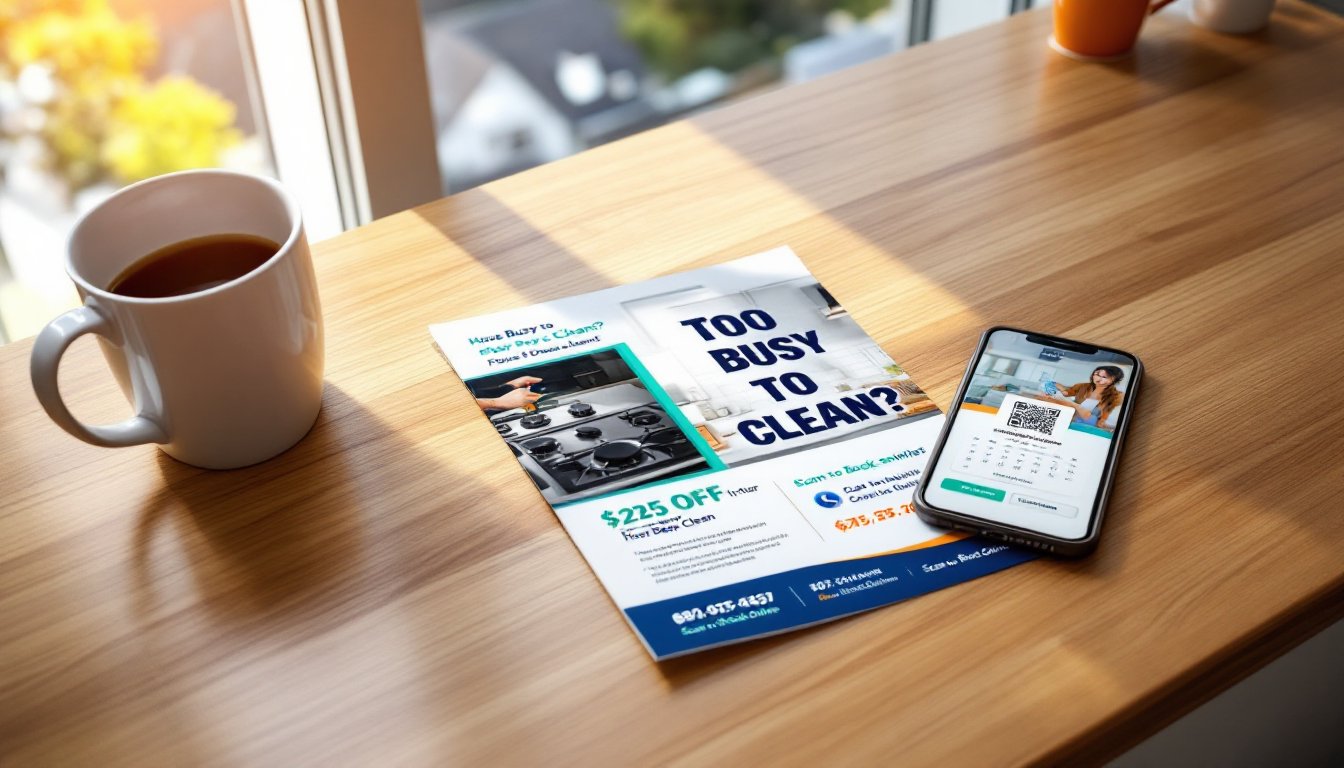
The headline needs to solve a problem in eight words or less. “Too Busy to Clean?” works because it names the pain point immediately. “Sparkling Homes, Stress-Free Scheduling” promises both a result and convenience. Skip generic phrases like “Professional Cleaning Services”, that’s a job description, not a reason to call.
Offers drive action more effectively than service lists. “$25 Off Your First Deep Clean” or “Free Kitchen Cleaning with Whole-House Service” gives prospects a concrete reason to try a new provider. Limited-time promotions work when the deadline is specific: “Book by May 15th” beats “Limited Time Offer.”
Visual hierarchy matters. The headline should be the largest text on the page, using bold sans-serif fonts like Arial Black or Montserrat Bold at 24–36 pt. The offer sits directly below in a contrasting color, ideally inside a border or shaded box that draws the eye.
Many cleaning organization methods emphasize systemized approaches, and the same principle applies to flyer layout, every element should have a clear purpose and position.
Contact Information and Call-to-Action
Phone numbers need to be huge, at least 18–22 pt and positioned both at the top and bottom of the flyer. Many people scan upward from the bottom, so redundancy ensures they don’t have to hunt for how to respond.
Multiple contact methods accommodate different communication preferences. List phone, text, email, and website (if it exists). Some prospects want to call immediately: others prefer texting or filling out a web form after kids are asleep.
The call-to-action should use active verbs and create urgency. “Call Today for Your Free Quote” outperforms “Contact Us.” “Text ‘CLEAN’ to 555-0199 for Instant Scheduling” works even better because it removes friction, no phone call required, no website to navigate.
QR codes bridge physical and digital marketing. A QR code linking to an online booking calendar or detailed service menu lets tech-comfortable prospects skip the phone call entirely. Position it in a bottom corner with a brief instruction: “Scan to Book Online.”
Design Tips to Make Your Flyer Stand Out From Competitors
Color psychology influences response rates more than most small businesses realize. Blue conveys trust and professionalism, good for corporate office cleaning. Green suggests eco-friendly products and health-conscious practices. Purple can signal premium or luxury services. Avoid muddy browns or grays that make a flyer look dirty before it’s even read.
High-contrast layouts improve readability at a glance. Dark text on light backgrounds always wins over reverse printing (white text on dark backgrounds), which can look cheap when printed on standard home or office printers. If using a colored background, keep it light, pastels work better than saturated tones.
Images should show results, not stock photos of smiling models holding spray bottles. A split image showing a grimy stovetop on the left and a gleaming one on the right communicates capability instantly. If using photos, ensure they’re high-resolution (at least 300 dpi) to avoid pixelation when printed.
White space isn’t wasted space, it’s breathing room that makes information digestible. Cramming every available inch with text creates visual chaos. Leave margins of at least 0.5 inches on all sides, and space out service bullets so each has room to register.
Professional design doesn’t mean expensive. Consistent alignment, a maximum of two font families (one for headlines, one for body text), and a simple color palette (two to three colors max) create polish. The best home improvement how-tos demonstrate that clarity beats complexity every time.
Strategic Distribution Methods That Get Results
Door hangers outperform mailbox flyers in most residential areas. They’re visible immediately when someone arrives home, and they can’t be dismissed as junk mail before being read. Use 4.25″ x 11″ door hanger stock with a tear-off business card at the bottom that people can stick on the fridge.
Target distribution by neighborhood demographics and timing. Hit family-heavy subdivisions on Thursday or Friday when parents are staring down a messy weekend. Distribute in condo complexes popular with young professionals on Sunday evenings when the work week looms. Skip rainy days, soggy flyers go straight to recycling.
Bulk mailings through USPS Every Door Direct Mail (EDDM) let businesses saturate specific carrier routes without buying mailing lists. Costs run around $0.18–$0.20 per piece for postage, plus printing. It’s cheaper than targeted Facebook ads in many markets and hits homeowners who’ve opted out of digital tracking.
Partner with complementary businesses for cross-promotion. Leave flyers at real estate offices (new homeowners need cleaners), home staging companies, and property management firms. Offer a referral fee, $25 per booked client, and suddenly office staff become an unpaid sales force.
Community bulletin boards still get eyeballs. Post tear-off tab flyers at grocery stores, libraries, coffee shops, and gym lobbies. Use bright 65 lb cardstock so tabs don’t rip prematurely, and check weekly to replace depleted ones, a board full of torn-off tabs signals demand to the next prospect.
Free and Low-Cost Tools to Create Professional Cleaning Flyers
Canva offers hundreds of cleaning service templates with drag-and-drop editing. The free version provides enough functionality for most small businesses, custom colors, photo uploads, and icon libraries. Upgrading to Canva Pro ($12.99/month) unlocks background remover tools and brand kit features that maintain consistency across all marketing materials.
Microsoft Word gets underestimated, but its flyer templates work fine for text-heavy designs. Use the built-in layout guides to maintain alignment, and stick to system fonts that print reliably (Arial, Calibri, Georgia). Export as PDF before printing to prevent font substitution issues.
For those comfortable with more control, GIMP is a free Photoshop alternative that handles layers, color correction, and text effects. The learning curve is steeper, but it’s capable of professional-grade output without subscription fees.
Print locally for small batches, use online services for volume. FedEx Office or Staples handle same-day printing of 50–100 flyers at reasonable quality. For runs of 500+, online printers like Vistaprint or GotPrint offer bulk discounts, often under $0.10 per flyer for simple designs on standard stock.
Paper weight matters more than most beginners realize. 80 lb gloss cover stock looks and feels more professional than standard 20 lb copy paper, which curls and tears easily. For door hangers, use at least 100 lb cover stock with a UV coating to resist weather.
Proofread three times before hitting print. Check phone numbers by dialing them, verify website URLs by clicking them, and confirm offer expiration dates. The credibility lost from a typo-riddled flyer can’t be recovered by clever design. Many resources emphasize attention to detail in home projects, and the same diligence applies to marketing materials that represent a business.
Test two versions with different headlines or offers. Print 100 of Version A and 100 of Version B, distribute them in comparable neighborhoods, and track which generates more calls. Data beats guesswork, and a 20% difference in response rate compounds quickly over thousands of flyers.